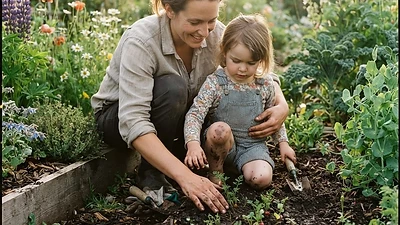
When modern parenting discourse turns toward sustainability, the conversation almost immediately defaults to shopping lists. Caregivers are presented with an exhaustive catalog of silicone snack bags, organic cotton rompers, non-toxic wooden blocks, and compostable nappies, each framed as an essential investment for an ethical future. Yet this commercial framing conceals an uncomfortable paradox: can we genuinely raise children to heal living systems by simply refining what we purchase?
True ecological literacy cannot be bought in a boutique aisle. Children rarely absorb their deepest operating ethics from the logos stamped on household goods; instead, they calibrate their understanding of reality by observing how adults navigate daily living, manage material resources, relate to the non-human world, and participate in community life.
Raising children with regenerative values requires shifting from transactional eco-consumerism toward embodied relational living. To cultivate genuine care for the Earth, families must anchor their daily rhythms in direct nature connection, deliberate consumption restraint, active community stewardship, and authentic parental role modelling.
Beyond Green Consumerism: Why Domestic Culture Matters
Modern childhood is increasingly mediated by screens and structured commercial experiences. When environmental stewardship is reduced to green consumption, children learn that planetary health is merely a matter of product preference rather than ecological kinship and collective responsibility. This superficial framing does little to insulate young minds from the prevailing culture of disposable convenience, nor does it prepare them to navigate ecological complexity.
The cultural patterns established inside the home form a child’s neurological baseline for what is normal, acceptable, and necessary. When domestic life treats resources as finite, living organisms as kin, and broken items as opportunities for care, children develop an instinctual alignment with natural cycles. This foundation matters because our collective ecological crisis is not merely technical; it is relational, rooted in a perceived separation from the natural systems that sustain us.
Primary Socialisation and the Power of Domestic Rhythms
Developmental psychology demonstrates that sustainable behaviours and environmental norms develop predominantly through primary socialisation—the continuous, unconscious observation and emulation of parents and primary caregivers. Children register how household members handle everyday friction far more clearly than they hear verbal lectures on conservation.

Daily domestic routines—such as actively sorting compost, turning down thermostats, maintaining a bicycle, or repurposing kitchen scraps—serve as living curricula. When these actions are integrated into ordinary family life without performance or sanctimony, children internalise a low-impact lifestyle as a foundational reality rather than a burdensome sacrifice. The language used around these choices is equally pivotal: framing conservation as active participation and joyful stewardship creates connection, whereas framing it as punitive deprivation can prompt resentment and reactive consumption later in life.
Critically, this socialisation dynamic is not a one-way street. Environmental sociologists recognise reverse socialisation as a powerful feedback mechanism within households. When children learn ecological concepts through nature immersion, community engagement, or school programs, they routinely bring those practices home, challenging and transforming adult habits. A child who learns to respect soil biology often becomes the catalyst for an entire family’s shift toward backyard composting or seeking regenerative produce at local Organic Eats.
Nature Connectedness as an Emotional and Cognitive Bedrock
A substantial body of research across early childhood environmental education confirms that early, unhurried exposure to natural environments enhances cognitive self-regulation, attention spans, social resilience, and overall emotional well-being. Regular sensory immersion in untamed green spaces allows children to experience biological processes first-hand—observing decay, growth, weathering, and renewal.
Crucially, this bond—often measured as Nature Connectedness (NC)—forms the psychological prerequisite for long-term ecological responsibility. Children who form deep emotional attachments to specific trees, creeks, or garden beds develop empathy for living systems that intellectual education alone cannot produce. Early kinship with nature provides psychological insulation against despair, fostering what researchers identify as constructive hope: an active, grounded agency that faces ecological disruption without paralysis.
Cultivating Regenerative Systems in Everyday Family Life
Moving beyond consumerism requires families to seek out tangible interactions with living systems, local businesses, and community networks. These choices manifest across several distinct domains of daily existence:

- Material Goods and Play: Prioritise open-ended, natural, or repaired objects over single-use toys. When purchasing is necessary, choosing durable goods from verified Conscious Brands or pre-loved exchanges demonstrates to children that objects carry a material lineage worth preserving.
- Food and Sourcing: Involve children in growing, harvesting, and preparing food. Visiting local farms, tending a modest windowsill garden, or participating in community-supported agriculture grounds abstract nutrition in living soil, teaching the biological realities behind everyday nourishment.
- Wellbeing and Healing: When addressing health and family balance, explore somatic and natural Treatments that help children tune into their own bodily cues, reinforcing the concept that human health mirrors planetary vitality.
- Gatherings and Community Action: Attend neighbourhood repair cafés, local habitat restoration days, and community Events. Witnessing adults collaborate to mend a park bench, plant native shrubs, or share seasonal harvests demonstrates that stewardship is a shared social practice, not an isolated household project.
- Shared Learning: Deepen collective understanding through family-oriented Courses that cover topics like permaculture principles, wild foraging, or zero-waste home skills, framing ecological learning as a shared adventure rather than adult dogma.
Structural Barriers, Privilege, and Evidence Gaps
While the regenerative parenting ideal is compelling, implementing it involves serious trade-offs and structural complexities that cannot be glossed over. Living regeneratively often demands substantial investments of unstructured time and geographical access—resources distributed unequally across modern societies.
Families living in dense, low-canopy urban centres or navigating economic precarity often lack convenient access to safe, biodiverse green spaces or bulk refilleries. For parents balancing non-standard shifts or multiple jobs, preparing scratch-cooked meals, repairing textiles, and commuting by cargo bike can present severe logistical friction. Acknowledging these inequities is essential: ecological family living must avoid turning into an insular aesthetic of moral superiority accessible only to the affluent.
Furthermore, critical gaps exist within the scientific literature. While early nature immersion shows strong immediate benefits for emotional regulation, rigorous longitudinal evidence tracking whether early childhood nature experiences directly translate into sustained pro-environmental behaviour in late adulthood remains modest and methodologically fragmented. Most studies rely on retrospective self-reporting rather than long-term cohort tracking. Similarly, researchers are only beginning to investigate the bidirectional relationship between heavy screen use, childhood nature alienation, and family relational health.
Another vital tension is the risk of premature exposure to planetary crises. Imparting the full weight of climate disruption, biodiversity loss, and systemic breakdown to young children without adequate emotional scaffolding can induce severe eco-anxiety. Adults must carefully manage this boundary, offering children deep sensory immersion in the wonders of the living world before asking them to carry the weight of its wounds.
Practical Shifts for the Conscious Household
Transitioning toward a regenerative family culture does not require an immediate lifestyle overhaul. Instead, it invites intentional adjustments to the household’s default operating habits:

- De-commercialise Celebrations: Shift the focus of birthdays, milestones, and seasonal holidays from material gift-piles toward shared rituals, communal meals, outdoor adventures, or slow travel Stays that prioritise shared presence over novelty.
- Narrate Daily Ecological Choices: Make household metabolic processes visible. Explain why vegetable peelings go to the worm farm, why a torn jacket is being patched rather than discarded, and how choosing active transit keeps local air clean, keeping the tone curious rather than moralistic.
- Normalise Material Limits: Build household comfort with the word “enough.” When children ask for novel toys seen in media, treat the desire as natural while establishing calm boundaries around consumption, exploring library borrowing, peer trading, or creative repurposing first.
- Carve Out Unstructured Wild Time: Protect regular, agenda-free hours in nature where children can climb trees, manipulate mud, observe insects, and encounter manageable physical risk, allowing nature connection to unfold organically without didactic instruction.
Examining the Evidence: Questions for Families
To cultivate authentic stewardship within the home, parents can look past marketing rhetoric and critically evaluate their family’s daily ecosystem. Consider exploring our News and Editorial archives for deeper perspectives, while reflecting on the following questions:
- Does our family schedule prioritise direct, unstructured engagement with the living world, or are our outdoor encounters largely managed, manicured, and transactional?
- Are our sustainability efforts primarily focused on ethical acquisitions from the Shop, or are we actively reducing the volume of material throughput entering and leaving our home?
- How do we discuss ecological challenges in front of our children—do our conversations communicate grounded agency and love for the living world, or do they cultivate anxiety and helplessness?
- Where does our family participate in mutual aid, community resilience, and shared care beyond the walls of our own residence?
- Are we providing our children with the tactile skills of repair, cultivation, and preservation, or are we inadvertently training them to be conscientious consumers?
An Ethos of Interdependence
Reframing parenting through a regenerative lens ultimately shifts our focus from producing eco-conscious individuals to nurturing deep, resilient connections. When we liberate our households from the exhausting demand for consumer perfection, we create room for genuine presence. Children do not require flawless zero-waste systems to develop empathy for the Earth; they need to witness adults who relate to the world with curiosity, reverence, and humility.
By grounding family life in mutual care, repair, and unhurried outdoor engagement, we offer young people something far sturdier than material goods: an internal compass calibrated for interdependence. In doing so, we prepare them not simply to endure ecological disruptions, but to participate actively and joyfully in the continuous mending of our shared world.
Frequently Asked Questions
How do I handle consumer pressure and toy requests from relatives?
Open communication centered on experiences often eases tension without creating conflict. Offer extended family specific alternatives, such as funding memberships to local nature reserves, contributing to outdoor gear funds, or gifting shared excursions that create lasting memories instead of accumulating plastic.
What if our family lives in a dense urban core without easy access to wild green spaces?
Ecological connection is not reserved solely for remote wilderness; it thrives wherever biological life persists. Cultivating herbs on a windowsill, monitoring seasonal changes in street-tree canopies, or caring for indoor plants teaches children fundamental biological cycles just as powerfully as a national park.
How can we talk to young children about climate change without inducing eco-anxiety?
Prioritise love and kinship over catastrophe during early developmental stages. Focus conversations on local stewardship, seasonal wonder, and tangible human problem-solving, introducing complex global vulnerabilities only as children develop the cognitive maturity to contextualise collective action.
How can busy working parents introduce regenerative habits without feeling overwhelmed?
Regenerative living is about simplifying rhythms rather than adding new domestic obligations. Start by involving children in existing chores—such as sorting organic waste or mending clothes—transforming essential household maintenance into shared relational learning moments rather than separate projects.